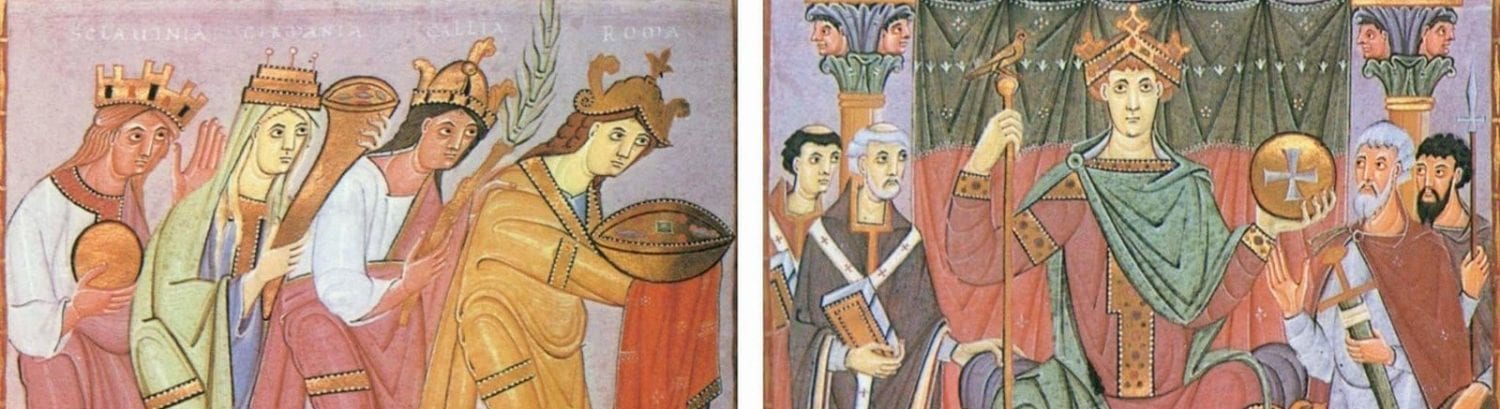
Roman Era
There is not much evidence describing economic activity in Pavia during the late Roman era, as it was a minor city, but there are some sources that tell us about the activity at the time. Circa 270, during the reign of Emperor Aurelian, a mint was established in the city, for example, but there is not evidence of this mint surviving past Constantine’s death [1].
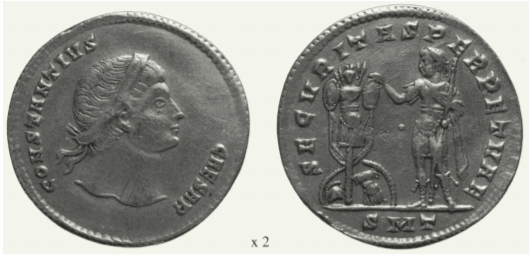
Later, Pavia had grown a little economically though it remained a relatively minor Italian city. By the fourth and fifth centuries, it became a popular stop on expeditions and had some factories built within the city.
Politically, Pavia had the most importance during the reign of Romulus Augustulus. His father, Flavius Orestes, effectively ruled for him, with Pavia as his capital. Orestes’ death in 476 and the takeover of the city by Odoacer is often cited as the fall of the Roman Empire. Besides that it played a generally minor role in the Roman political scene.
One of the best sources for the time is Ennodius’s Life of St. Epiphanius [2]. From his account we know that Pavia, while important, was considered to be a lot smaller than other prominent Italian cities. During this time, Epiphanius, Bishop of Pavia, held a lot of power, and used it do aid in negotiations between rival political groups. When Odoacer took over, Epiphanius convinced him to release many of the Roman elites he had captured. The bishop’s power was maintained despite the many changes in political leadership, showing the stability preserved by the Catholic Church.
Ostrogothic Era
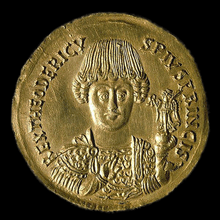
The Ostrogothic era, like the Roman era before, served as a key transition point toward Pavia’s role as an economic and political capital of Italy. Before the Ostrogoths, when Odoacer took the city, the inhabitants were relieved of their taxes for five years as reparations for the dramatic damage that the city undertook during the conquest [3]. Partly as a result of this previous damage, it was one of several cities that were renovated during Theodoric’s reign and after [4].
The Ostrogothic era brought many other physical changes to the city. Even before Theodoric, the influx of Ostrogoths necessitated rebuilding parts of Pavia to accommodate them. Under Theodoric, it’s walls were rebuilt and the palace that would later serve as the seat of Lombard political power was originally constructed [5]. These fortifications and palaces would later prove critical in Pavia becoming a capital of the Lombard Kingdom, which was the single greatest change in Pavia’s economic and political role. In general, like most Roman cities under Theodoric, Roman political and economic institutions were largely upheld.
Some other minor evidence exists of economic activity during this period. In particular, Cassiodorus, a statesman in Theodoric’s administration, wrote about the state granaries in Pavia [6]. Despite the evidence of Pavia’s economic growth, both Cassiodorus and Ennodius’ writings indicate that the late fifth and early sixth centuries were an era of economic hardship for the area.
Lombard Era
Pavia’s greatest point as an economic and political city occurred during the Lombard period, which extends from around 568 to 774, after the Lombard invasion of Northern Italy and before the Carolingian conquest, though the actual divide is far from that precise. It was during this period that Pavia became the capital of the Lombard Kingdom, a decision that drastically altered its political and economic scale . However, it did take until about 620 before it fully ingrained itself as the capital of the kingdom [7].
By far the biggest change during the period was the royal court moving to Pavia. The heart of the Kingdom’s politics occurred within the royal court, which meant the political administration and players all moved to Pavia. In the court itself, the political landscape became a mix of traditional Lombard roles (marpahis, scilpor, scaffard, antepor, stolesaz) and other more Roman offices(maiordomus, vesterius, camerarius, actionarius, referendarius), a common trend in the Lombard period [8]. Most of the Lombard ones were generally indistinct and the Roman offices are more often seen on law documents. These officeholders held public duties in the city itself, but also worked as a kind of representative for Italy as a whole, demonstrating the widespread political network that spanned from Pavia, the capital. It was not just the people in the King’s court that bore political significance. The court itself, or the royal palace, also held political import. An Ostrogothic palace converted to serve the needs of the Lombard’s, it stood as an emblem of the political power and majesty of the royalty, court, and king [9].
The Lombard Kingdom had largely removed the traditional Roman land tax, which led to Pavia becoming increasingly economically and politically important. The lack of a land tax made personal property the predominant way for the king or his vassals to field an army or exercise power. This directly linked landowning with political power. Since cities were of particular prominence in Italy they had an increased value, especially a capital like Pavia [10]. This meant that Pavia was actually an integral link to the King’s political and economic power or hegemony.
Other, more minor, economic effects to Pavia during the era were that Pavia became the center of minting and price-fixing as well as the spot where the central administration resided [11].
Carolingian Era
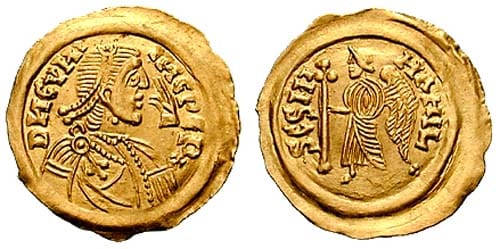
There was Frankish diplomatic activity in Pavia fairly steadily beginning in 752, but the Lombards completely lost their control of Pavia in 774, when Charlemagne conquered Desiderius’ realm and declared himself King of the Lombards. The fact that Charlemagne continued to acknowledge the Lombards as separate from the Franks is significant. This trend can be seen in the monetary systems Charlemagne used. Initially, he continued to use the tremissis, or Lombard currency, even minting some of his own (one of the mints he used was in Pavia). He did eventually introduce more typically Carolingian currency in the form of silver pennies. While there is some controversy as to how long Lombard currency circulated, the use of these coins did not continue on after Charlemagne’s reign [12].

The continuation of largely independent Lombard rule within Charlemagne’s reign appeared in more than just the coinage. In the political sense, Charlemagne originally replaced many of the Lombard dukes with Frankish counts, but he tended to return Lombards to these positions after the counts’ deaths. Furthermore, Charlemagne’s relationship with Pope Hadrian showed many of the same rivalries as the Pope’s relationship to the Lombards. However, Hadrian did recognize Charlemagne as King [13].
In general, Charlemagne and the other Frankish kings tended to separate themselves politically from Italy. Despite this, Charlemagne did make his son Pepin King of the Lombards in 781. Pavia would continue to be a strong player during the reign of Louis the II, and evidence from coins points to Pavia and its mint being continually important to the Carolingian economy. Louis II ruled Italy more closely than Charlemagne did, but even he used the administration already in place at Pavia.
Post-Carolingian Era
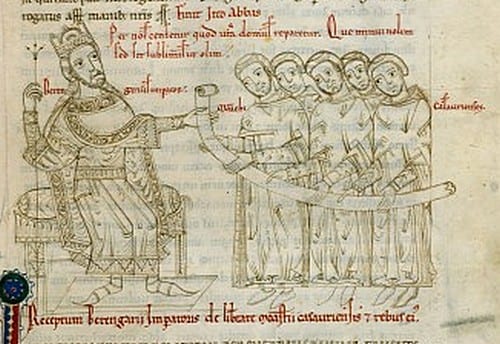
The post-Carolingian period for Pavia occurred around 888, the traditional date when the Carolingian Empire divided itself and when Berengar I took control of Italy. Pavia continued to serve as the de facto capital of the Italian kingdom for several centuries afterwards, well past 1000, and remained one of the most stable European capitals in the period [14]. The palace at Pavia was still the political fulcrum for the Italian Kingdom as a whole but to a lesser degree. Carolingian policies had taken root in Italy after the Carolingian era, putting more focus and detail into local policies and claims [15]. These policies and Berengar I’s own failings resulted in less central importance around the King and, by extension, his capital at Pavia. Essentially, the Kingdom itself had become weaker as the period went on, which meant that the relative economic and political centrality of its capital declined as well despite the central administration remaining in Pavia. The economic effect was similar. Pavia did see some foreign trade flow through and around it, but, in general, the relative economic centrality of the Italian capital underwent a harsh decline [16].
However, with the Ottonian conquest of Italy in around 960, Pavia saw increased economic importance as a trading city during the early 1000s. The Po River connected Pavia to Venice, and many luxury goods were transported to Pavia for sale. Additionally, Pavia became a center for buying silk, and many of the city’s inhabitants got wealthy off of long distance trade [17]. It remained an Italian capital through the period but didn’t reach the political importance or economic centrality it had once held.
Bibliography
- Bullough, D. A. “Urban Change in Early Medieval Italy: The Example of Pavia.” Papers of the British School at Rome, vol. 34, 1966, pp. 83.
- The Life of St. Epiphanius. Translated by Genevieve Cook.
- Thompson, E. A. Romans and Barbarians: the Decline of the Western Empire. University of Wisconsin Press, 2002. p 64.
- Moorhead, John. Theoderic in Italy. Clarendon Press, 1999. p 139.
- ^Moorhead. Theoderic in Italy. p 139.
- Bullough, D. A. “Urban Change in Early Medieval Italy: The Example of Pavia.” Papers of the British School at Rome, vol. 34, 1966, p. 93.
- Christie, Neil. The Lombards the Ancient Longobards. Blackwell, 1998. p. 79.
- Wickham, Chris. Early Medieval Italy. Macmillan, 1980. pp. 38-39.
- ^Wickham. Early Medieval Italy. p. 80.
- ^Wickham. Early Medieval Italy. pp. 39-41.
- ^Wickham. Early Medieval Italy. p. 39.
- Sabater, M. Crusafont I. “An Unpublished Ravenna Tremissis of Charlemagne.” The Numismatic Chronicle, vol. 164, 2004, p. 244.
- Hallenbeck, Jan T. “Pavia and Rome: The Lombard Monarchy and the Papacy in the Eighth Century.” Transactions of the American Philosophical Society, vol. 72, no. 4, 1982, p. 167.
- Arnaldi, Girolamo. Italy and Its Invaders. Harvard University Press, 2008. p. 5.
- Foot, John, and Giuseppe Di Palma. “Italy.” Encyclopædia Britannica, Encyclopædia Britannica, Inc., 6 Mar. 2019, britannica.com/place/Italy/Carolingian-and-post-Carolingian-Italy-774-962. p. 3.
- Hyde, John Kenneth. Society and Politics in Medieval Italy. Macmillan, 1973. pp. 16-17.
- Bruce, Scott Gordon. “Monks Tell Tales.” Cluny and the Muslims of La Garde-Freinet: Hagiography and the Problem of Islam in Medieval Europe, Cornell University Press, 2015, p. 46.

· Permalink
Four books so far.
Paul the Deacon: History of the Lombards
Neil Christie: The Lombards
John Moorhead: Theoderic in Italy
Wickham: Early Medieval Italy
· Permalink
Some links to articles:
https://www.jstor.org/stable/1006429
Title: Pavia and Rome: The Lombard Monarchy and the Papacy in the Eighth Century
https://www.jstor.org/stable/40310664
Title: Urban Change in Early Medieval Italy: The Example of Pavia
· Permalink
Chapter 2, the section labeled “By Savage Hands Restrained”, seems useful.
https://www.jstor.org/stable/10.7591/j.ctt15hvs4r
· Permalink
Decided on Wednesday: Splitting up into time periods
Roman (Short)
Ostrogoths & Theoderic
Lombards/Byzantine
Carolingian
Post-Carolingian (may specify more later)
· Permalink
Spencer/Isabel: Ostrogoths & Theoderic
Spencer: Lombards
Isabel: Carolingian
Isabel: Roman
Spencer and Isabel: Post-Carolingian
· Permalink
I think its best if we combine the sections on Roman Pavia and Ostrogothic Pavia. Let me know if you think differently.
· Permalink
Let me see if I can find more on the Roman era. If not, that sounds good.
· Permalink
I think there’s actually a lot to be said about Roman Pavia and that it should have its own section
· Permalink
That’s totally fine then.
· Permalink
Also, here’s a link to the notes
https://docs.google.com/document/d/15dPzc5wJvJmzzlgGBpdg0IoDLkmigS6jIFHkgEPmuUM/edit
· Permalink
Here’s where I got the picture of the coin:
https://www.jstor.org/stable/42666411
· Permalink
This article describes the role of Epiphanius, a bishop in Pavia during the “fall” of Rome. (Pages 162-163 are particularly helpful)
https://www.jstor.org/stable/10.7834/phoenix.66.1-2.0158
· Permalink
https://www.worldcat.org/title/romans-and-barbarians-the-decline-of-the-western-empire/oclc/248884064/viewport
Pages 63-64.
· Permalink
Thanks for the articles. I’ve copied the Lombard stuff from the drive onto the site itself. I’ll move the Ostrogothic and post-Carolingian eras after I edit them a bit more.
Also, if you have some good information about the economy in Pavia, during the Ostrogothic era, I would appreciate if you could forward that to me.
· Permalink
Ok sounds good!
· Permalink
How should we go about citing our sources in the text of the wiki?
· Permalink
I have a reference page at the bottom of my notes. I plan to just do footnotes Wikipedia style, which is what I think the other groups are doing.
· Permalink
Scratch that, I’m going to do MLA. (Author pg.#)
· Permalink
Here’s a good overview article I found sometime last week for post-Carolingian/Carolingian. I don’t know if I’ve shared it with you yet. I’m not sure if we should rely too heavily on it for citations, but it has some really good supplemental info to fill out the gaps.
https://www.britannica.com/place/Italy/Carolingian-and-post-Carolingian-Italy-774-962
· Permalink
I’m wondering if we should rename the Post-Carolingian section Post-Carolingian/Ottonian? My main source for this is this passage, from this source: https://www.jstor.org/stable/pdf/10.7591/j.ctt15hvs4r.7.pdf?refreqid=excelsior%3A08573a8eff70c26fd7412564c70f2dcc
“Although the evidence is not abundant, it seems quite clear that
the imperial seat of the Ottonians in northern Italy was a thriving commercial center well situated on a lucrative transalpine trade route that connected
northern Europe with the riches of the Mediterranean. In the ninth and
tenth centuries, silk and other fine goods made their way up the Po River
from Venice to the markets of Pavia. In the 890s, Venetian traders active in
the city sought out the saintly nobleman Gerald of Aurillac to sell him their
wares, including cloaks and spices, as he camped near Pavia en route from
Rome to Burgundy. By the early eleventh century, Pavia and Ferrara, the
latter a market town in the Po watershed near Ravenna, enjoyed a monopoly
on the sale of silks in Italy. Long-distance trade made the citizens of Pavia
prosperous, a fact that found expression in the rich array of religious and
domestic building projects that adorned their city.”
· Permalink
· Permalink
Yeah, that’s fine. I was planning to end with the Ottonians, but what you did is good.
· Permalink
Could you add the citation for Cassiodorus in the Ostrogothic section?